The Debt Jubilee Delusion: Why Slate-Wiping Always Rewards the Wrong People

The Ancient Promise of Clean Slates
Every few decades, political movements rediscover debt forgiveness as the solution to economic inequality. The proposal sounds revolutionary: wipe away accumulated debts, give struggling families fresh starts, reset the economic playing field. Contemporary advocates point to ancient precedents—Mesopotamian kings who proclaimed debt jubilees, Athenian reforms that freed debt slaves, biblical commands to cancel obligations every seven years.
What these modern proposals rarely mention is what actually happened after historical debt cancellations. The pattern is consistent across millennia and civilizations: debt forgiveness programs primarily benefit the creditor class that designs them.
Solon's Seisachtheia: The Original Bait and Switch
In 594 BCE, Athens faced a debt crisis that threatened social collapse. Small farmers had borrowed against their land and labor, creating a class of debt slaves who worked their former properties for creditors. The situation was politically unsustainable—revolution seemed imminent.
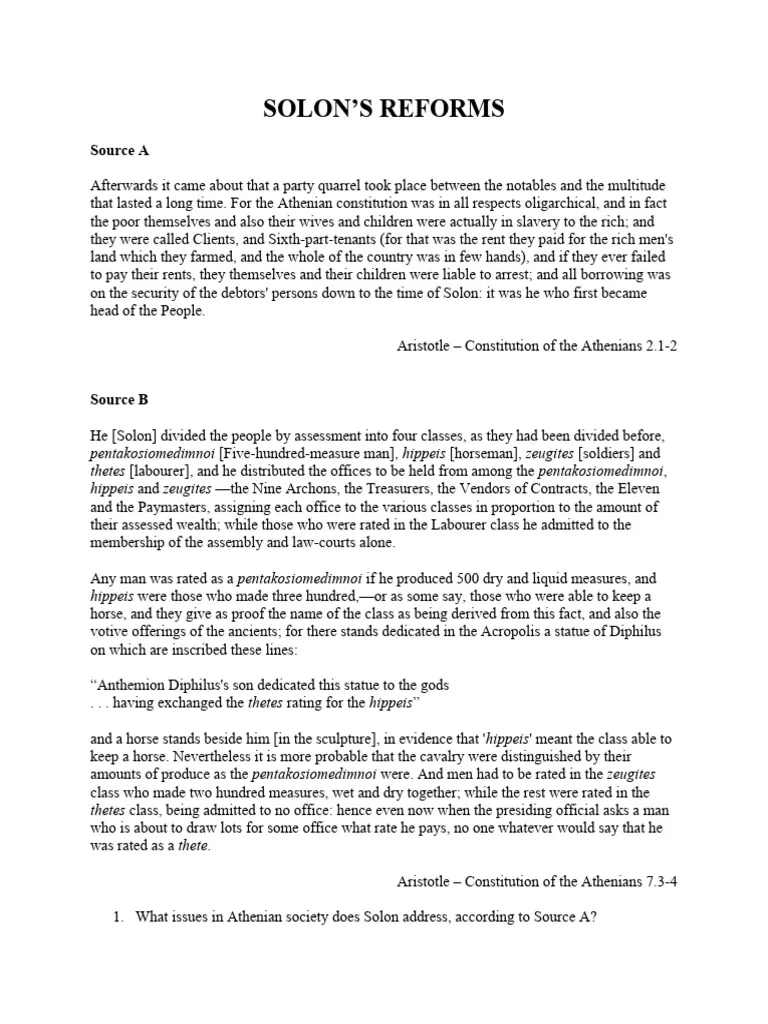 Photo: Solon, via imgv2-1-f.scribdassets.com
Solon, appointed as archon with extraordinary powers, implemented the seisachtheia—literally "shaking off of burdens." All existing debts were cancelled. Debt slaves were freed. Land seized for non-payment was returned to original owners. Contemporary sources describe jubilant celebrations as families reunited and farmers reclaimed their fields.
The celebration was premature. Within a generation, the same families were back in debt to the same creditors. Solon's reforms had addressed symptoms while strengthening underlying causes.
The key insight lies in understanding who controlled credit markets before and after cancellation. Wealthy Athenians who had accumulated land through debt foreclosures didn't lose their fundamental advantages—they lost specific assets while retaining the capital, connections, and commercial knowledge that had generated those assets originally.
Meanwhile, the freed debtors received land without receiving the financial literacy, market access, or capital reserves necessary to maintain independence. Most were borrowing again within months, often from the same creditors who had previously enslaved them.
The Mesopotamian Model: Institutionalized Forgiveness
Mesopotamian kingdoms developed the most sophisticated debt forgiveness systems in ancient history. Kings regularly proclaimed andurarum—releases that cancelled debts, freed debt slaves, and returned foreclosed properties. These weren't emergency measures but routine administrative functions, occurring every few years with clockwork regularity.
Modern economists initially interpreted these jubilees as evidence of enlightened social policy. Closer examination reveals a more complex dynamic. Mesopotamian debt cancellations functioned as economic reset mechanisms that preserved existing power structures while preventing revolutionary upheaval.
The crucial detail is what debts were cancelled and which were preserved. Royal proclamations typically forgave obligations between private parties—farmers' debts to landlords, artisans' debts to merchants, laborers' debts to employers. But commercial debts between merchants, obligations to temple institutions, and taxes owed to royal treasuries remained enforceable.
This selective forgiveness created predictable arbitrage opportunities. Sophisticated creditors learned to structure loans through institutions exempt from cancellation. Wealthy merchants developed financial instruments that converted private debts into commercial obligations. The debt jubilee system didn't eliminate exploitation—it professionalized it.
The Roman Precedent: When Forgiveness Triggers Collapse
Roman debt crises followed different patterns because Roman law treated debt obligations as sacred contracts that couldn't be unilaterally cancelled. This created periodic pressures for debt relief that Roman politicians struggled to address without undermining property rights.
The most instructive case occurred in 49 BCE, when Julius Caesar implemented partial debt forgiveness as civil war erupted. Caesar's measures reduced interest payments, allowed debtors to surrender property at pre-war valuations, and prohibited creditors from holding more than a certain amount in cash.
 Photo: Julius Caesar, via c8.alamy.com
The immediate result was economic chaos. Creditors hoarded money rather than lending it. Property values collapsed as distressed sales flooded markets. Commercial activity ground to a halt as merchants refused to extend credit. Caesar's debt relief triggered the very economic crisis it was designed to prevent.
The deeper problem was expectations. Once Roman markets believed debt cancellation was politically possible, credit relationships became fundamentally unstable. Borrowers delayed payments hoping for future relief. Creditors demanded higher interest rates to compensate for cancellation risks. The mere possibility of debt forgiveness made debt more expensive and less accessible.
The Modern Student Loan Parallel
Contemporary student loan forgiveness proposals follow identical logic to ancient debt jubilees, with predictable results already becoming visible. Universities have raised tuition costs in direct proportion to federal loan availability, creating the debt crisis that forgiveness programs claim to address.
The primary beneficiaries of student loan cancellation wouldn't be struggling graduates but the institutional creditors who issued the original loans. Federal forgiveness programs transfer private obligations to public balance sheets, socializing losses while privatizing the gains that created those losses.
Meanwhile, the underlying dynamics that generate student debt—unlimited federal lending, accreditation barriers that restrict competition, employer credentialism that requires degrees for routine jobs—remain completely unchanged. Debt forgiveness without structural reform simply resets the cycle while teaching institutions that overcharging carries no consequences.
The Psychological Trap
Debt forgiveness programs persist across cultures and centuries because they exploit fundamental features of human psychology. Voters focus on immediate relief rather than long-term consequences. Politicians prefer visible gestures to complex structural reforms. Creditor interests align with debtor emotions to create coalitions for policies that benefit neither group's stated objectives.
The pattern repeats because the underlying incentives never change. Debt forgiveness shifts obligations from private parties to public institutions without addressing the power imbalances that created exploitative lending relationships originally. The same creditor class that profits from debt creation also profits from debt cancellation, just through different institutional channels.
Understanding this historical pattern doesn't argue against addressing debt crises—it argues for addressing them intelligently. Real solutions target the structural advantages that allow creditor classes to repeatedly capture debtor populations, rather than providing temporary relief that strengthens long-term exploitation.
Five thousand years of evidence suggests that debt forgiveness without institutional reform is just wealth transfer with extra steps.