The Mercenary Trap: Every Great Power Rents Its Army Once. Most Do It Until It Kills Them.
The Mercenary Trap: Every Great Power Rents Its Army Once. Most Do It Until It Kills Them.
The decision makes sense every single time it is made. Raising and maintaining a professional army from a state's own population is extraordinarily expensive. It requires not only soldiers' pay but pensions, training infrastructure, logistical systems, and the political cost of compelling citizens to accept military service. Hiring soldiers — or, in the modern formulation, contracting military services to private firms — solves all of these problems simultaneously. The costs are variable rather than fixed. The liability is contractual rather than political. When the contract ends, the obligation ends.
This logic has been compelling enough to seduce every major power in recorded history into some version of the arrangement. It has also, with a consistency that should give pause to any serious strategist, produced a recognizable set of downstream consequences that the historical record documents in detail. The United States, which now spends more on private military and security contractors than most nations spend on their entire defense establishments, is not the first great power to make this bet. It is the latest in a very long line.
Rome's Calculation and Its Consequences
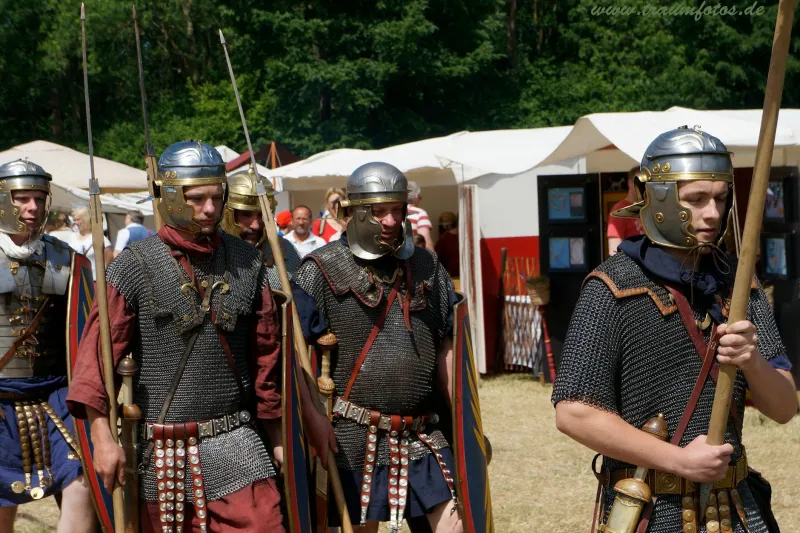
The Roman legions of the Republic and early Empire were citizen armies in a meaningful sense: soldiers with a stake in the state they defended, recruited from a property-owning class that had political representation and civic identity. By the third century CE, the pressures of frontier defense across an enormous perimeter had made this model unsustainable. The empire was too large, the threats too numerous, and the citizen population too reluctant to fill the ranks voluntarily.
The solution was the foederati: Germanic and other tribal warriors recruited en masse under their own leaders, fighting under Roman command but retaining their own internal organization, loyalties, and cultural identity. The arrangement was economical. Germanic warriors were formidable fighters, available in large numbers, and accustomed to conditions that would have broken Roman recruits. For a generation or two, the system functioned adequately.
What Rome was actually doing, however, was transferring military institutional knowledge out of Roman hands and into those of commanders whose primary loyalty was to their own people and their own advancement. Stilicho, the half-Vandal general who served as the effective military guardian of the Western Empire in the late fourth and early fifth centuries, is the paradigm case. He was, by most accounts, genuinely committed to Rome's survival. He was also the product of a system that had made Roman military capacity dependent on men whose ties to Rome were contractual and personal rather than constitutional and civic. When Stilicho was executed in 408 CE — a victim of court politics — the Visigothic forces he had managed through personal relationships promptly sacked Rome under Alaric. The institutional knowledge walked out with the contractor.
The Pattern Repeats Across Centuries
The British East India Company's experience with its sepoy regiments offers a more recent and more extensively documented version of the same dynamic. The Company built its Indian empire on the back of locally recruited infantry trained and equipped to European standards. The arrangement was, from a purely financial standpoint, brilliant: Indian soldiers cost a fraction of what British troops cost, could be recruited in numbers that the British Isles could not have supplied, and were initially highly effective.
The 1857 Rebellion — still debated in terms of its causes, but not in terms of its consequences — demonstrated the structural vulnerability embedded in this model. An army recruited from a population whose interests and grievances differ from those of the employer is an army that has the capacity, under the right conditions, to reverse its allegiance. The Company's military capacity was not ultimately a Company asset. It was a borrowed asset, held under conditions that the Company did not fully control.
The British Crown's response after 1857 — reasserting direct state control over Indian military forces and dramatically increasing the proportion of British troops — was an expensive acknowledgment that the outsourcing model had a liability that did not appear on the balance sheet until it detonated.
The Modern Contractor Ecosystem
The United States began its serious expansion of private military contracting in the 1990s, accelerated dramatically after 2001, and has never meaningfully reversed course. At the height of operations in Iraq and Afghanistan, contractor personnel outnumbered uniformed military in theater. The functions outsourced extended far beyond logistics and base support — the traditional domains of military contracting — into intelligence analysis, interrogation, training of foreign forces, and armed security operations.
The efficiency arguments for this model are genuine. Contractors can be surged and drawn down without the political friction of activating reserves or extending deployments. They bring specialized skills — cyber operations, language capabilities, technical maintenance — that the military would struggle to develop and retain internally given civil service pay constraints. The costs appear in discretionary budget lines rather than in the politically sensitive personnel accounts that drive military end-strength debates.
The costs that do not appear on those budget lines are worth examining with the historical record in mind.
First, institutional knowledge migration. When a military function is contracted out over a sustained period, the organic capacity to perform that function atrophies within the uniformed force. The contractors who now perform much of the U.S. military's intelligence analysis, logistics management, and weapons system maintenance are not simply augmenting military capacity. In many domains, they have replaced it. The question of what happens when those contracts end, or when the contracting firms' interests diverge from the government's, deserves more serious attention than it typically receives.
Second, loyalty structure. Private military contractors are loyal to their contracts, their shareholders, and, in the case of individual employees, their paychecks. This is not a criticism — it is a description of how contractual relationships function. But it means that the reliability of contractor performance in high-stakes, ambiguous situations is a function of contract design and oversight, not of the institutional culture and civic obligation that historically bound professional soldiers to their states. The historical record on what happens when those two things diverge is not encouraging.
Third, the political economy of dependency. Once a government has transferred significant military capacity to private contractors, reversing that transfer is extraordinarily difficult. The contractors employ large workforces in congressional districts. They build political relationships. They develop proprietary systems that create switching costs. The foederati commanders of late Rome were not easy to dismiss either, once the legions had been allowed to atrophy.
The Hidden Cost, Compounding
The most important feature of the mercenary trap is its time horizon. The benefits of military outsourcing are immediate and visible: lower per-unit costs, flexible capacity, reduced political friction. The costs are deferred and structural: eroded institutional capacity, misaligned incentives, and a gradual transfer of military knowledge and leverage to entities whose interests are not identical to the state's.
This mismatch between when the benefits appear and when the costs appear is precisely why the trap catches every great power that approaches it. No Roman emperor decided to hollow out the legions. No East India Company board voted to create a dependency on sepoy forces that would eventually prove uncontrollable. Each individual decision was rational given the information available at the time. The catastrophe was the accumulation of those rational decisions over decades.
The United States is not Rome. The analogy has limits that any serious analyst should acknowledge. But the underlying dynamic — a great power substituting contracted military capacity for organic institutional capacity because the short-term economics are compelling — is not an analogy. It is a pattern, documented across three millennia, with a consistent terminal chapter.
Five thousand years of data. The conclusions are available to anyone who chooses to draw them.